

Wine Cap
Stropharia rugosoannulata
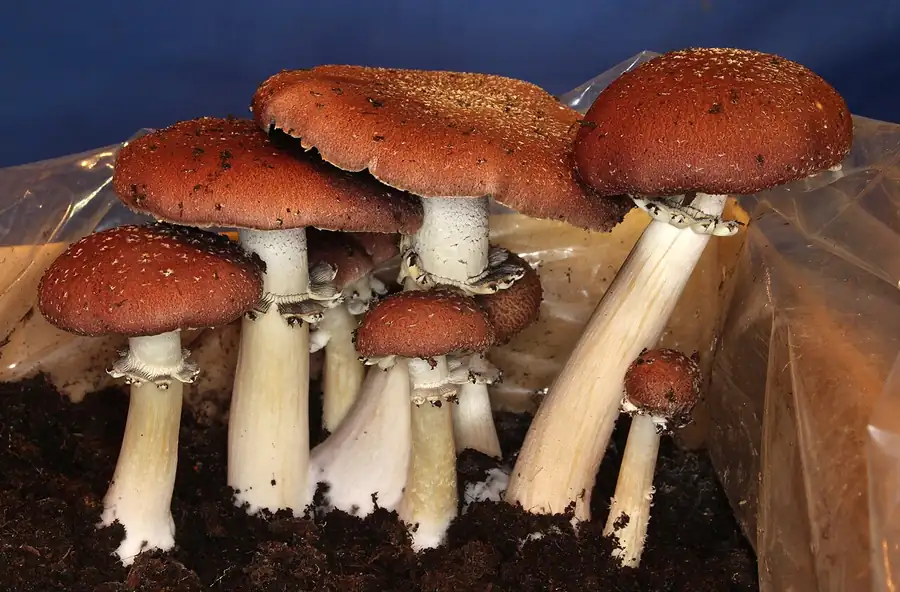
The wine cap, also called king stropharia or garden giant, is the outdoor mushroom of the cultivated group: it grows on wood chips and straw, tolerates a very wide temperature range and is grown on more than 6,000 hectares in China.
Stropharia rugosoannulata feeds on cellulose, hemicellulose and lignin from agricultural and forestry residues such as crop straw, tree litter and manure-based mixes. In a 2025 review its mycelium grew between 5 and 35 °C with an optimum of 26 °C, preferring a substrate moisture of 65–80% (75% ideal). Fruiting is triggered by a drop in temperature to 10–20 °C at 95%+ humidity, after which the fruit bodies prefer 85–95% air humidity. Temperature shapes the crop: at about 16 °C or lower the mushrooms are stout and compact, while at about 24 °C or higher they are slender and loose and open sooner.
Cultivation parameters
Climate
| Colonization temperature | 26 °C |
|---|---|
| Overall cultivation temperature | 5–35 °C |
| Fruiting temperature | 10–20 °C |
| Fruiting humidity | 85–95% |
| Air / CO₂ notes | Mycelium grows between 5 and 35 °C with an optimum of 26 °C; growth slows below 10 °C and above 35 °C inhibits or kills it. Primordia form after a drop to 10–20 °C at 95%+ humidity. Fruit bodies are stout and compact at about 16 °C or lower and slender and loose at about 24 °C or higher. |
| Cold shock | Not required (primordium formation is triggered by a drop in temperature to 10–20 °c) |
Timing & substrate
| Primary substrate | Straw and wood chips |
|---|---|
| Substrate options | Wood chips, Crop straw, Tree litter, Livestock and poultry manure mixes |
Spawn & substrate preparation
| Substrate moisture | 65–80% |
|---|
Practical literature-range
| Best methods | Outdoor beds on straw, wood chips or other agricultural and forestry residues |
|---|---|
| Difficulty | Beginner — Grows on a wide range of straw, wood and plant residues and is recommended by the FAO for cultivation in developing countries |
Taxonomy & ecology
| Scientific name | Stropharia rugosoannulata |
|---|---|
| Also known as | Wine-red stropharia, King stropharia, Garden giant, Burgundy mushroom, Giant stropharia |
| Synonyms | Geophila rugosoannulata |
| Family | Strophariaceae |
| Order | Agaricales |
| Genus | Stropharia |
| Lifestyle | Saprotroph |
| Natural habitat | Wood chips in summer and autumn |
| Native range | North America and Europe; introduced to Australia and New Zealand |
| Cultivation status | Commercially cultivated |
How to grow Wine Cap, step by step
- Choose and prepare the substrate. Use clean straw, wood chips or other agricultural or forestry residues and bring them to about 65–80% moisture, ideally around 75%.
- Add spawn. Mix or layer the spawn through the substrate in a bed.
- Let the mycelium run. Aim for about 26 °C, within the 5–35 °C the mycelium tolerates; keep it moist.
- Trigger fruiting. A drop in temperature to about 10–20 °C with very high humidity triggers primordia.
- Keep humidity up and harvest. Hold humidity around 85–95% so the stems do not crack, and pick the mushrooms as they mature.
Growing notes
Wine caps are mostly grown outdoors, so yield and cycle depend on the weather, particularly temperature and humidity. Keep the bed moist: when relative humidity drops below 60% the stipes are more likely to crack, and a study at 24 °C and 70% humidity showed stipes growing from 4.2 cm to 13.1 cm in only four days before stopping. The mycelium can take up toxic heavy metals such as mercury and cadmium from soil or substrate, so choose clean materials. Spent substrate can go back onto the field, where it improves soil structure and fertility.
Safety notes
- The mycelium can accumulate toxic heavy metals such as mercury and cadmium from soil or substrate, so use clean substrate.
Questions about growing Wine Cap
What temperature does the wine cap need?
Mycelium grows between 5 and 35 °C, with an optimum of 26 °C. Growth slows below 10 °C and temperatures above 35 °C inhibit or kill it. Primordia form after a drop to 10–20 °C.
What substrate does the wine cap grow on?
A wide range of agricultural and forestry residues: crop straw, tree litter, wood chips and livestock or poultry manure mixes. The ideal substrate moisture is about 75% within a 65–80% range.
Why do wine cap stems crack?
Low humidity. When relative humidity falls below 60% the stipes are more likely to crack, so keep the surface moist and the air at about 85–95% humidity while the mushrooms grow.
Does the wine cap grow wild?
Yes. It is found on wood chips in summer and autumn across North America and also in Europe, and has been introduced to Australia and New Zealand. This page is about cultivation and cannot help identify wild mushrooms.
Is it a commercial crop?
Yes. China grew 494,745 tonnes of wine cap in 2023, more than 17 times the 2017 figure, on over 6,000 hectares.