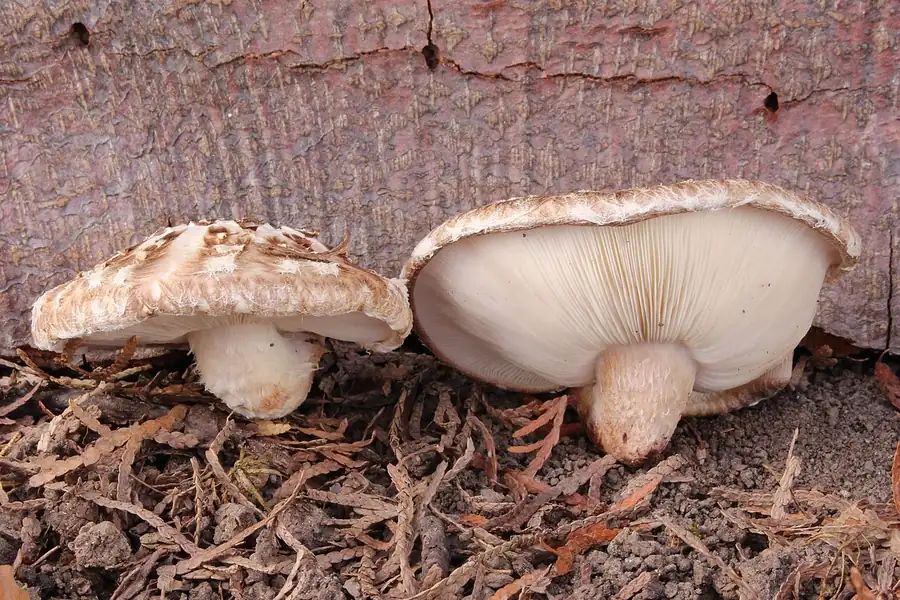
Shiitake rewards patience: it is a slower, more demanding grow than the oysters, with a long colonization period and a cold shock needed to trigger fruiting, but it is a classic for good reason.
Shiitake (Lentinula edodes) is a culinary species grown mainly on hardwood sawdust blocks or on logs. Colonization takes about 50–70 days at 20–24 °C, with humidity held around 85–90%. After roughly 60% colonization the block is rested at about 20 °C. Fruiting is not automatic: a cold shock — about 4 °C for 24 hours, or a drop of 10–15 °C — is required to trigger pins. Once triggered, pins form in 5–8 days and mature in another 7–10, fruiting at 13–21 °C under low indirect light with medium fresh-air exchange.
Fruiting temp
13–21 °C
Fruiting humidity
85–90%
Colonization
50–70 d
Bio. efficiency
75–125%
Cultivation parameters
Climate
Colonization temperature
20–24 °C
Fruiting temperature
13–21 °C
Incubation humidity
85–90%
Fruiting humidity
85–90%
Fresh-air exchange
Medium
Light
Low indirect
Air / CO₂ notes
Rest at ~20 °C after roughly 60% colonization.
Cold shock
Required — 4 °C for 24 h, or a 10–15 °C drop, to trigger fruiting
Timing & substrate
Colonization
50–70 days
Pinning
5–8 days
Maturation (pin to harvest)
7–10 days
Flush interval
14–21 days
Time to first flush
~60 days on sawdust; 9–12 months on logs.
Primary substrate
Hardwood sawdust
Substrate options
Hardwood sawdust, Logs
Yield
Biological efficiency
63% (first flush, approximate)
Flushes
2–3, roughly every 2 weeks — roughly 55% / 30% / 15% of total
Practical literature-range
Best methods
Sawdust blocks, Outdoor bed
Watch for
Green Mold (Trichoderma), Black Mold (Aspergillus / Rhizopus), Colonization Stall, Mycelial Overlay / Stroma
Difficulty
Intermediate — Long colonization plus a required cold shock to trigger fruiting
Taxonomy & ecology
Scientific name
Lentinula edodes
Growing notes
On sawdust, the first flush comes after about 60 days; on logs, plan on 9–12 months. Biological efficiency on a first flush is around 63%, and the planning range for the whole crop is 75–125%, spread across two or three flushes roughly every two weeks (about 55% / 30% / 15% of the total). Because colonization is long, sterile technique matters more here than with fast oysters: green mold, black mold, a stalled colonization or an overlay are the problems to watch for. Build the cold shock into your schedule from the start, and use the timeline planner to see where it falls.