

Button Mushroom
Agaricus bisporus
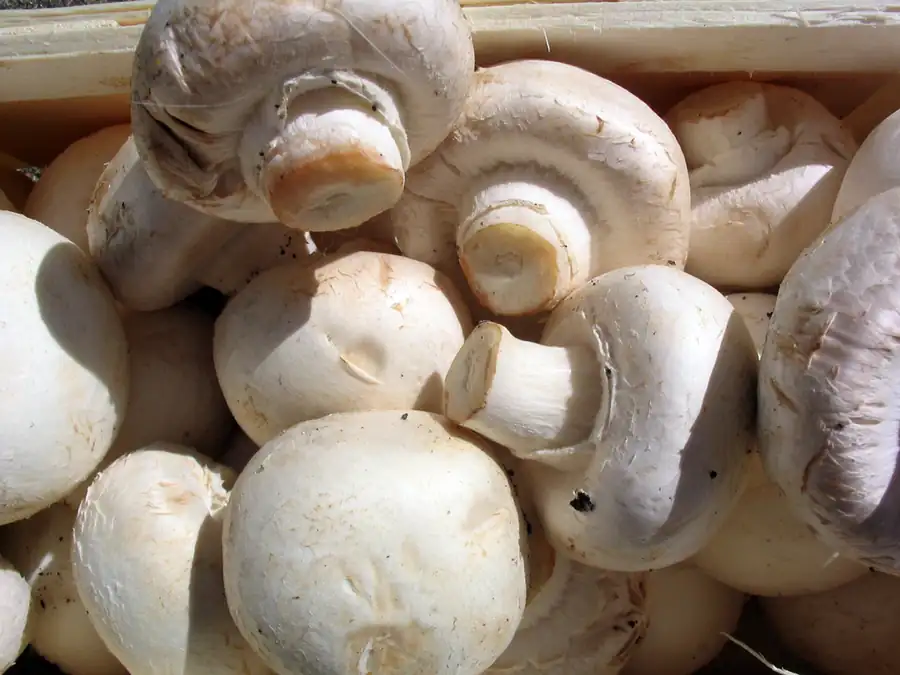
The button mushroom is the workhorse of mushroom farming: the same species is sold as white button, brown cremini and large portobello, and it is cultivated in more than 70 countries.
Agaricus bisporus grows on composted straw rather than raw wood or straw, and it will not fruit without a casing layer laid over the colonised compost. In a controlled research-unit crop, the cased trays spent a week at 25 °C compost and 21 °C air with 96–100% humidity, were then cooled over three days to about 20 °C air while fresh air was introduced, and finally cropped at 18 °C air over two or three flushes of mostly closed cups. Reported biological efficiency on composted wheat straw ranges from about 47% to 100%. It is a rewarding but demanding crop: composting, casing and climate control all matter.
Cultivation parameters
Climate
| Colonization temperature | 21–25 °C |
|---|---|
| Overall cultivation temperature | 20–35 °C |
| Fruiting temperature | 18–20 °C |
| Incubation humidity | 96–100% |
| Air / CO₂ notes | Fruiting is induced by lowering temperature and carbon dioxide and by venting; fresh air is introduced at the end of the case-run phase. |
| Cold shock | Not required (pinning is triggered by a gradual temperature drop and fresh air after the casing layer is colonised, not by a cold shock) |
Timing & substrate
| Time to first flush | In one research-unit crop cycle: 7 days of case run, a 3-day cool-down, 5 more days, then harvesting flushes at 18 °C. |
|---|---|
| Primary substrate | Composted wheat straw (phase II compost) with a peat-based casing layer |
| Substrate options | Composted wheat straw, Composted oat straw, Non-composted substrates (experimental) |
Yield
| Biological efficiency | Typical range 47–100% |
|---|---|
| Harvest notes | Harvested mostly as closed cups over two to three flushes. |
Practical literature-range
| Best methods | Tray or shelf growing on composted substrate in a climate-controlled room |
|---|---|
| Watch for | Cobweb Mold (Dactylium) |
| Difficulty | Advanced — Needs composted substrate, a casing layer and tight climate control, which makes it harder than oyster mushrooms |
Taxonomy & ecology
| Scientific name | Agaricus bisporus |
|---|---|
| Also known as | White button mushroom, Champignon, Cremini, Portobello |
| Synonyms | Psalliota hortensis f. bispora |
| Family | Agaricaceae |
| Order | Agaricales |
| Genus | Agaricus |
| Lifestyle | Saprotroph |
| Natural habitat | Rich soil, compost and manure in grassland |
| Native range | Grasslands of Eurasia and North America; cultivated in more than 70 countries |
| Cultivation status | Commercially cultivated |
How to grow Button Mushroom, step by step
- Make and condition the compost. Compost the straw-based mix in phase I, then pasteurise and condition it in phase II until the ammonia is gone.
- Spawn and colonise. Mix spawn into the compost and let the mycelium colonise it before casing.
- Apply the casing layer. Cover the colonised compost with a nutrient-poor casing; the cited trial used 50 mm of peat-based casing.
- Run the case. Hold compost around 25 °C and air around 21 °C at 96–100% humidity for about a week while the mycelium grows into the casing.
- Cool and ventilate to trigger pins. Introduce fresh air and lower the temperature gradually over about three days to roughly 20 °C air, then hold for a few days.
- Harvest the flushes. Keep the room around 18 °C and pick the mushrooms, mostly as closed cups, over two to three flushes.
Growing notes
Compost is made in two phases. Phase I is thermophilic composting in which the pile can reach up to 80 °C; phase II pasteurises the compost and conditions it until the ammonia is gone. After spawning and colonisation the compost is covered with a casing layer; in the cited trial this was 50 mm of peat-based casing. The casing is a nutrient-poor layer that supports the mushrooms, holds water and hosts bacteria, and fruiting is triggered by lowering temperature and carbon dioxide and by venting. Two named crop diseases in the cited trial were dry bubble disease (Lecanicillium fungicola) and cobweb disease, so keep the room clean and monitor the crop closely. Home growers usually start with ready-made kits because of the composting step.
Questions about growing Button Mushroom
Are button, cremini and portobello mushrooms the same mushroom?
Yes, they are all Agaricus bisporus. White button mushrooms are the young pale form, cremini are a brown form, and the mature brown mushroom with a cap of roughly 10–15 cm is sold as portobello.
Why does the button mushroom need a casing layer?
It forms few or no fruit bodies without one. The casing is a nutrient-poor layer laid over the colonised compost; it supports the mushrooms, acts as a water reservoir and hosts bacteria that help trigger fruiting.
What temperature does the button mushroom need?
In a controlled research crop the compost ran at 25 °C with 21 °C air and 96–100% humidity during the first week after casing, then the room was cooled to about 20 °C air and 21 °C compost over three days, and harvest flushes ran at 18 °C air. The FAO training manual gives a 20–30 °C interval for white strains and 20–35 °C for brown strains in Thailand's winter crop.
How is the compost prepared?
In two phases. Phase I is thermophilic composting where the pile reaches up to 80 °C. Phase II pasteurises the compost and conditions it until the ammonia has been removed.
How much can be harvested?
Reported biological efficiency on composted wheat straw is about 47–100%. In the cited crop trial mushrooms were picked mostly as closed cups over two to three flushes.
Does the button mushroom grow in the wild?
Yes. It is native to grasslands in Eurasia and North America and grows in rich soil, compost and manure, but this page is about cultivation and cannot help identify wild mushrooms.