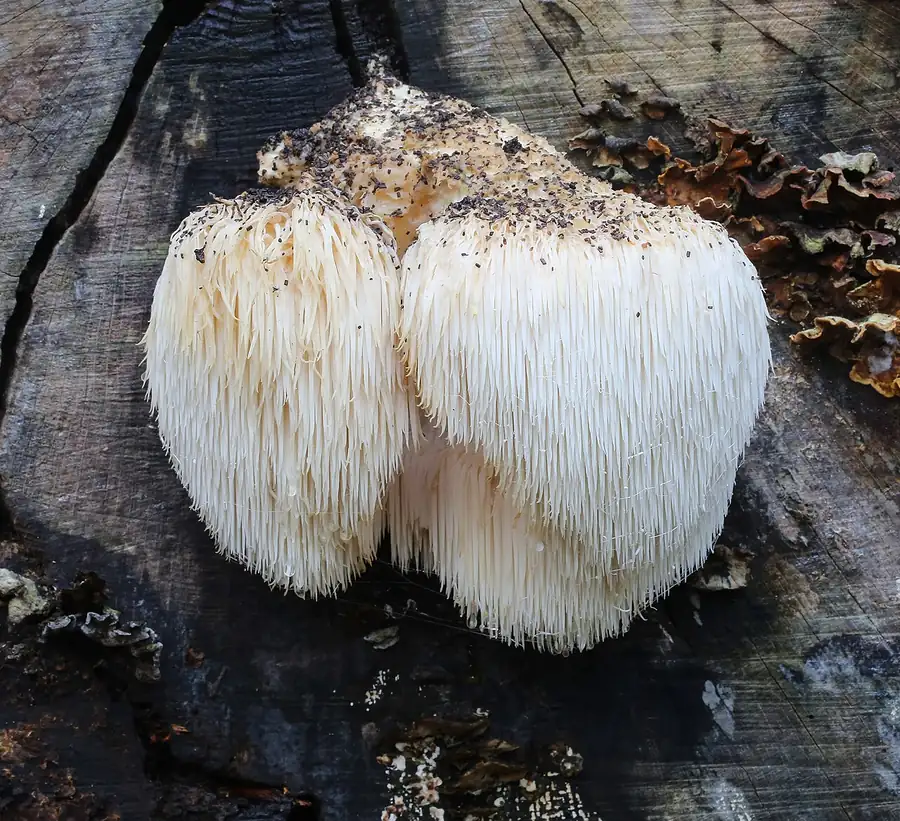
Lion's mane is both a culinary and a medicinal mushroom, with cascading white spines that look unlike anything else you can grow. It is rewarding, but it is humidity-sensitive and physically fragile.
Hericium erinaceus grows on supplemented hardwood sawdust and colonizes in 12–18 days at 21–24 °C with humidity at 85–95%. It fruits at 16–21 °C, again at 85–95% humidity, under low indirect light with moderate fresh air — around three to four air exchanges per hour. Pins appear in 5–7 days and mature in 7–10, with the first flush arriving about a month after inoculation. The expected biological efficiency is a planning range of 50–100%, with roughly 60% of the crop in the first flush.
Fruiting temp
16–21 °C
Fruiting humidity
85–95%
Colonization
12–18 d
Bio. efficiency
50–100%
Cultivation parameters
Climate
Colonization temperature
21–24 °C
Fruiting temperature
16–21 °C
Incubation humidity
85–95%
Fruiting humidity
85–95%
Fresh-air exchange
Medium
Light
Low indirect
Air / CO₂ notes
Moderate fresh air exchange, roughly 3–4 exchanges per hour.
Cold shock
Not required
Timing & substrate
Colonization
12–18 days
Pinning
5–7 days
Maturation (pin to harvest)
7–10 days
Flush interval
12–16 days
Time to first flush
~1 month after inoculation.
Primary substrate
Supplemented hardwood sawdust
Substrate options
Supplemented hardwood sawdust
Yield
Biological efficiency
Typical range 50–100%
Flushes
3 (roughly 60% / 25% / 15% of total)
Harvest notes
Fragile; handle gently.
Yield notes
Low humidity produces a dense 'blob' instead of spines.
Intermediate — Beginner-to-intermediate; humidity-sensitive and physically fragile
Taxonomy & ecology
Scientific name
Hericium erinaceus
Growing notes
Humidity is the thing to watch. If it drops too low, lion's mane forms a dense blob rather than the long spines it is known for, so keep the fruiting space consistently humid without letting it stagnate. The fruit is fragile, so handle it gently at harvest. Grow bags, sawdust blocks and ready-made grow kits all work. Along with the usual green mold and cobweb mold, low-humidity blobs and aborted pins are the failure modes to look for. The 12–16 day gap between flushes gives you time to reset conditions between harvests.