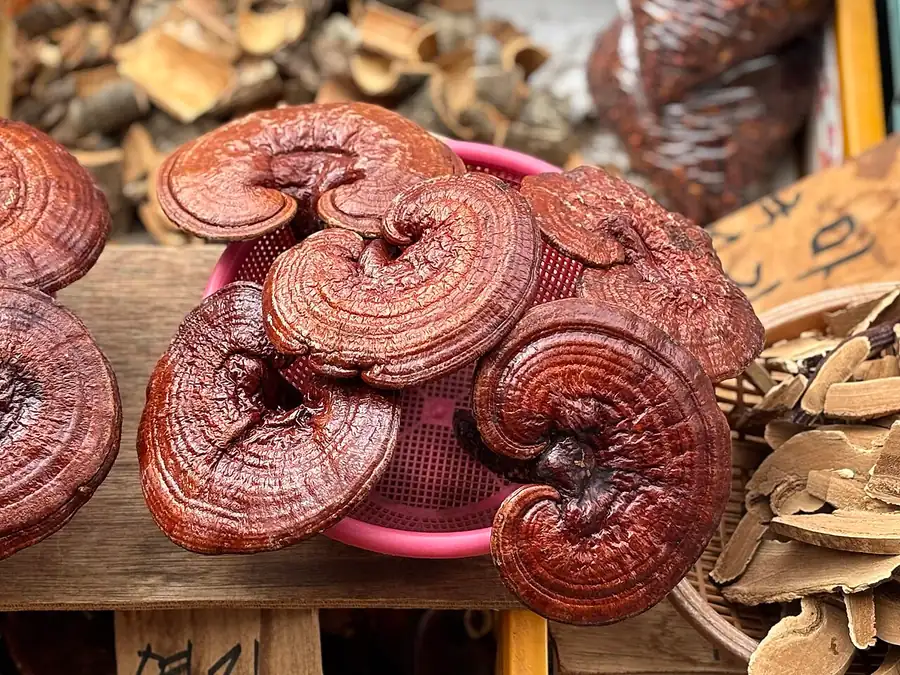
Reishi is a slow, decorative medicinal mushroom with a glossy, antler-like or conk-like fruiting body. It is not a quick crop, but the shape you get is largely in your hands.
Ganoderma lucidum is grown on supplemented hardwood sawdust and likes it warm: colonization runs at 24–30 °C and takes 14–21 days, with humidity at 90–95%. Fruiting is at 21–27 °C, again at 90–95% humidity, with low fresh-air exchange and low indirect light. Pins take 10–18 days to appear, and maturation is long at 40–60 days. Unlike most species here it is a single, long grow rather than repeated flushes, with a biological efficiency planning range of 30–60%.
Fruiting temp
21–27 °C
Fruiting humidity
90–95%
Colonization
14–21 d
Bio. efficiency
30–60%
Cultivation parameters
Climate
Colonization temperature
24–30 °C
Fruiting temperature
21–27 °C
Incubation humidity
90–95%
Fruiting humidity
90–95%
Fresh-air exchange
Low
Light
Low indirect
Air / CO₂ notes
High CO2 yields antler form; low CO2 plus light yields the flat conk form.
Cold shock
Not required
Timing & substrate
Colonization
14–21 days
Pinning
10–18 days
Maturation (pin to harvest)
40–60 days
Flush interval
Single flush
Primary substrate
Supplemented hardwood sawdust
Substrate options
Supplemented hardwood sawdust
Yield
Biological efficiency
Typical range 30–60%
Flushes
1 (single long grow)
Yield notes
Slow, decorative and medicinal.
Practical literature-range
Best methods
Sawdust blocks, Climate chamber
Watch for
Green Mold (Trichoderma), Black Mold (Aspergillus / Rhizopus), Mycelial Overlay / Stroma
Difficulty
Intermediate — Slow grow; final shape depends on CO2 and light
Taxonomy & ecology
Scientific name
Ganoderma lucidum
Growing notes
The form of the fruiting body depends on CO₂ and light. High CO₂ gives the antler form; low CO₂ together with light gives the flat conk form. Decide which you want before you open the bag, and manage fresh air accordingly. Because the grow is slow and warm, sterile technique and clean handling matter: green mold, black mold and overlay are the contaminants to watch for. Sawdust blocks and a climate chamber are the best methods, and these figures are literature ranges you should verify for your strain.