

Enoki
Flammulina filiformis
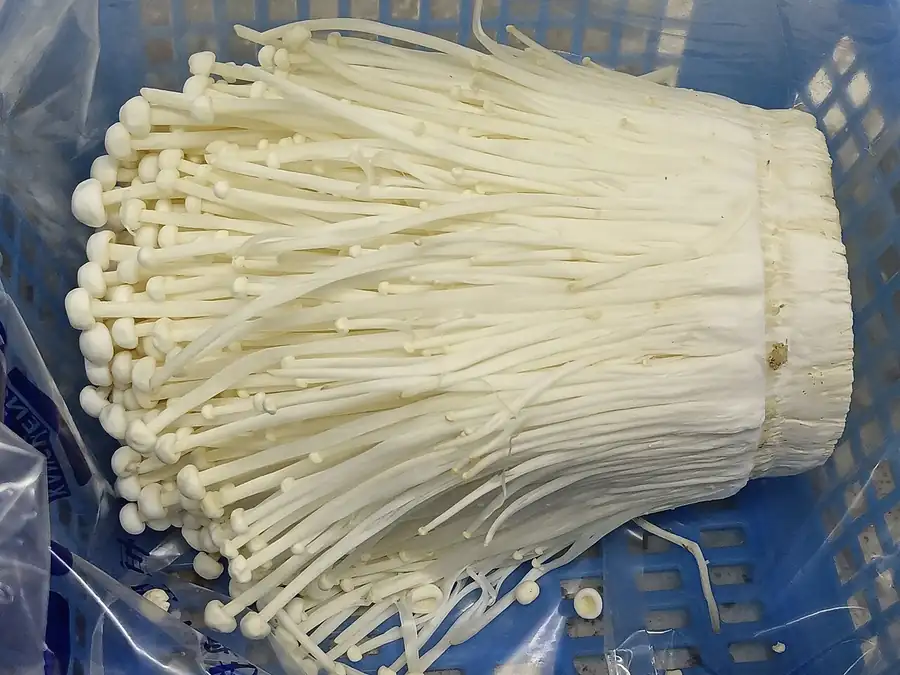
Enoki is the cold-loving oddball of cultivated mushrooms: it fruits at fridge-like temperatures and, grown in the dark, produces the long, pale, noodle-thin stems with tiny caps that many people know from shops.
Cultivated enoki (Flammulina filiformis, long sold in cultivation literature as Flammulina velutipes) runs warm during incubation, around 18–25 °C, but needs a drop to roughly 7–10 °C to start pinning and does best fruiting at about 10–16 °C with 85–95% humidity. Commercial crops grow on supplemented sawdust or agricultural residues such as cottonseed hulls and corncobs with rice bran, usually in bottles or bags kept in darkness. The cool requirement is the main hurdle: the FAO manual lists enoki as a winter crop in Thailand, growing at 8–15 °C (brown strain) or 8–20 °C (white strain).
Cultivation parameters
Climate
| Colonization temperature | 18–25 °C |
|---|---|
| Fruiting temperature | 8–16 °C (tolerant to ~20 °C) |
| Fruiting humidity | 85–95% |
| Light | None |
| Air / CO₂ notes | Commercially grown in darkness, which gives long, narrow, pale stems with undeveloped caps; light gives shorter, coloured stems. Pinning is triggered at 7–10 °C and about 95–100% humidity. |
| Cold shock | Not required (fruiting needs a drop to roughly 7–10 °c to start pinning) |
Timing & substrate
| Time to first flush | About 42 days from inoculation to harvest in the best-performing bottle treatment of a 2024 trial. |
|---|---|
| Primary substrate | Supplemented hardwood sawdust |
| Substrate options | Hardwood sawdust with wheat or rice bran, Cottonseed hulls and corncobs with rice bran, Wheat or paddy straw |
Yield
| Biological efficiency | 123.5% (reported with 30% bran added to cottonseed hulls; depends strongly on the recipe) |
|---|---|
| Harvest notes | Harvest when the stems are about 5–10 cm long. |
| Yield notes | First-flush yield reached about 356 g per bottle in the best treatment of a 2024 bottle-culture trial. |
Practical literature-range
| Best methods | Bottle culture in a cool room, Bag culture in a cool room |
|---|---|
| Difficulty | Intermediate — Needs a cool room (roughly 8–16 °C) and high humidity to fruit, which makes it harder in warm climates |
Taxonomy & ecology
| Scientific name | Flammulina filiformis |
|---|---|
| Also known as | Winter mushroom, Golden needle mushroom, Enokitake |
| Synonyms | Flammulina velutipes var. filiformis, Flammulina velutipes (older cultivation literature) |
| Family | Physalacriaceae |
| Order | Agaricales |
| Genus | Flammulina |
| Lifestyle | Saprotroph |
| Natural habitat | Wood-decaying fungus; in cultivation it grows on lignocellulosic substrates such as sawdust and straw |
| Cultivation status | Commercially cultivated |
How to grow Enoki, step by step
- Mix and sterilise the substrate. Combine supplemented sawdust (or cottonseed hulls and corncobs) with a nitrogen source such as rice or wheat bran, fill bottles or bags and sterilise them; the cited trial used 121 °C for 2 hours.
- Inoculate. Add spawn under clean conditions and close the containers.
- Incubate in the dark. Hold the containers at about 18–25 °C in darkness until the substrate is fully colonised; the cited trial used 18 °C.
- Trigger pinning. Scrape the surface lightly and move to a cool, humid room: pinning starts at around 7–10 °C and about 95–100% humidity, and the trial fruited at 14 °C and 90–92%.
- Support the stems. When the fruits stand a few centimetres above the container, add a paper collar and keep the room at about 8–12 °C so the stems stay straight and long.
- Harvest. Cut the cluster when the stems are about 5–10 cm long.
Growing notes
In a 2024 bottle-culture trial the substrate was sterilised at 121 °C for 2 hours, incubated at 18 °C in the dark, scraped on the surface once fully colonised, and then fruited at 14 °C and 90–92% humidity with light from the third day; a paper collar was added when the fruits stood 2–3 cm above the bottle and the temperature was lowered to 8–12 °C until harvest. The best recipe finished in about 42 days and gave roughly 356 g per bottle in the first flush. The same study found that the ratio of carbon to nitrogen in the substrate matters: a ratio of about 27:1 shortened the cycle and raised yield. Without a cool room the crop is difficult, so plan the season or the space around the temperature.
Questions about growing Enoki
What temperature does enoki need?
Incubation runs at about 18–25 °C. Pinning is triggered at roughly 7–10 °C, and the best fruiting range is about 10–16 °C. The FAO manual gives a cultivation interval of 8–15 °C for a brown strain and 8–20 °C for a white strain.
Why are cultivated enoki so long and pale?
They are grown in the dark. Under those conditions the fruit bodies develop long, narrow stems with undeveloped caps; exposed to light they form shorter, coloured stems with more normal caps.
What substrate does enoki grow on?
Supplemented hardwood sawdust is the standard base. Cottonseed hulls, corncobs, soybean straw and rice bran have been used in trials, and the species also grows on wheat or paddy straw. One reported recipe mixed 18% wheat bran, 80% sawdust and 2% lime for spawn.
How long does enoki take from inoculation to harvest?
In the best treatment of a 2024 bottle-culture trial the whole cycle took about 42 days. Other recipes and temperatures take longer, so treat this as a best-case figure rather than a promise.
Can I grow enoki at home in a warm climate?
It is hard. Pinning needs a drop to about 7–10 °C and fruiting stays best at 10–16 °C, so without a cool room or refrigerated space the crop tends to fail. In Thailand it is grown only as a winter crop.