

Maitake
Grifola frondosa
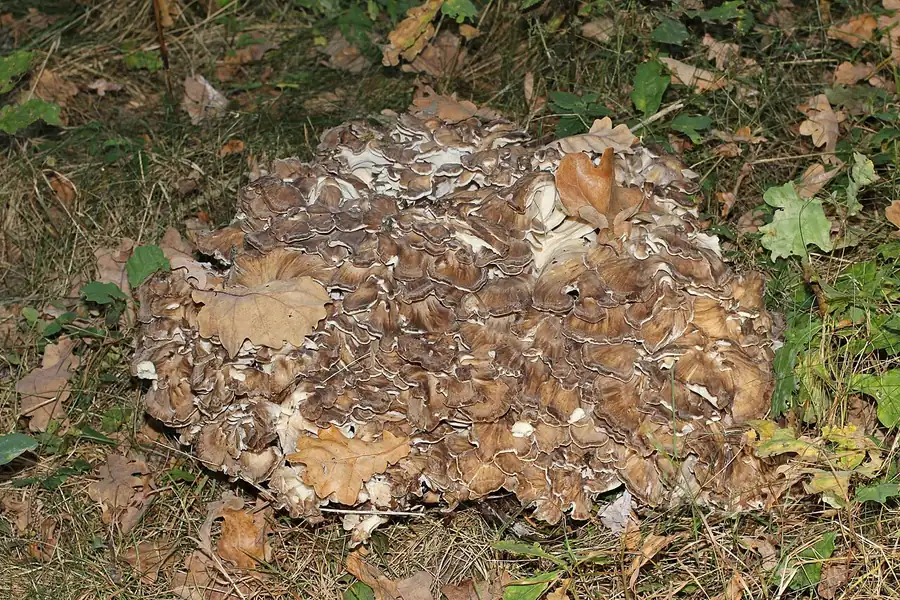
Maitake, or hen-of-the-woods, grows wild at the base of old oaks and maples and is cultivated in bags of supplemented sawdust or corn cob, though it is slower and fussier than oysters.
Grifola frondosa is native to China, Europe and eastern North America. In a 2018 trial in China, autoclaved bags (about 62.5% moisture) were incubated at 23–26 °C in darkness with CO2 under 3,000 ppm, then moved to a fruiting chamber at 19–21 °C, 93–97% humidity, 400–700 ppm CO2 and 12 hours of light. The best formula was 73% corn cob, 2% rice straw, 23% wheat bran and 2% calcium carbonate, which gave about 135 g in the first flush per bag (biological efficiency about 45%). The shortest cycles from inoculation to first harvest were about 63 days.
Cultivation parameters
Climate
| Colonization temperature | 23–26 °C |
|---|---|
| Fruiting temperature | 19–21 °C |
| Fruiting humidity | 93–97% |
| Air / CO₂ notes | In a 2018 bag trial, incubation ran at 23–26 °C in darkness with CO2 under 3,000 ppm; fruiting ran at 19–21 °C, 93–97% humidity, 400–700 ppm CO2 and 200 lux for 12 hours a day. |
| Cold shock | Not required |
Timing & substrate
| Primary substrate | Sawdust or corn cob with wheat bran |
|---|---|
| Substrate options | Sawdust, Corn cobs, Soybean straw, Rice straw, Wheat bran |
Spawn & substrate preparation
| Substrate moisture | 62–63% |
|---|
Practical literature-range
| Best methods | Autoclaved supplemented-substrate bags |
|---|---|
| Difficulty | Intermediate — Needs a long run (about two months to first harvest in a trial), tight fruiting-room control and a bag opened at the right moment |
Taxonomy & ecology
| Scientific name | Grifola frondosa |
|---|---|
| Also known as | Hen-of-the-woods, Ram's head, Sheep's head |
| Genus | Grifola |
| Lifestyle | Parasite |
| Natural habitat | Base of trees, particularly old oaks or maples |
| Native range | China, Europe and eastern North America |
| Cultivation status | Commercially cultivated |
How to grow Maitake, step by step
- Mix and bag the substrate. Blend corn cob or sawdust with wheat bran and a little calcium carbonate, adjust moisture to about 62%, and fill bags.
- Sterilise. Autoclave the bags (the trial used 121 °C for 85 minutes) and let them cool.
- Inoculate and incubate. Add spawn and incubate at 23–26 °C in darkness with CO2 under 3,000 ppm until the bag is colonised and primordia start.
- Fruit. Open the bag and move it to 19–21 °C, 93–97% humidity, 400–700 ppm CO2 and 12 hours of light.
- Harvest. Pick the first flush once the clustered caps are formed; the quickest trial cycles took about 63 days from inoculation.
Growing notes
The figures above come from one first-flush trial, so treat the yield as a conservative reference, not a promise. Corn cob raised yield, while sawdust shortened the growth cycle. Very high nitrogen can drive vigorous mycelium that accumulates unwanted metabolic products, and too little carbon or nitrogen causes early ageing or slow growth.
Questions about growing Maitake
What temperature does maitake need?
A 2018 bag trial incubated at 23–26 °C and fruited at 19–21 °C with 93–97% humidity.
What substrate works for maitake?
Sawdust and corn cob are the main ingredients, with wheat bran, rice or soybean straw and a little calcium carbonate. The best formula in the trial was mostly corn cob.
How long does maitake take to fruit?
In the trial, the quickest formulas reached the first harvest in about 63 days from inoculation.
How much does maitake yield?
The best trial formula gave about 135 g per bag in the first flush, a biological efficiency of about 45%.
Does maitake grow wild?
Yes, at the base of old oaks and maples in China, Europe and eastern North America. This page covers cultivation only and cannot help identify wild mushrooms.